Excavation and base
Dig to depth, aggregate laid and compacted in lifts, graded to drain. The part that decides everything.

Artificial Turf / Turf Installation
Turf does not fail because of the turf. It fails because of what somebody did or did not do underneath it.
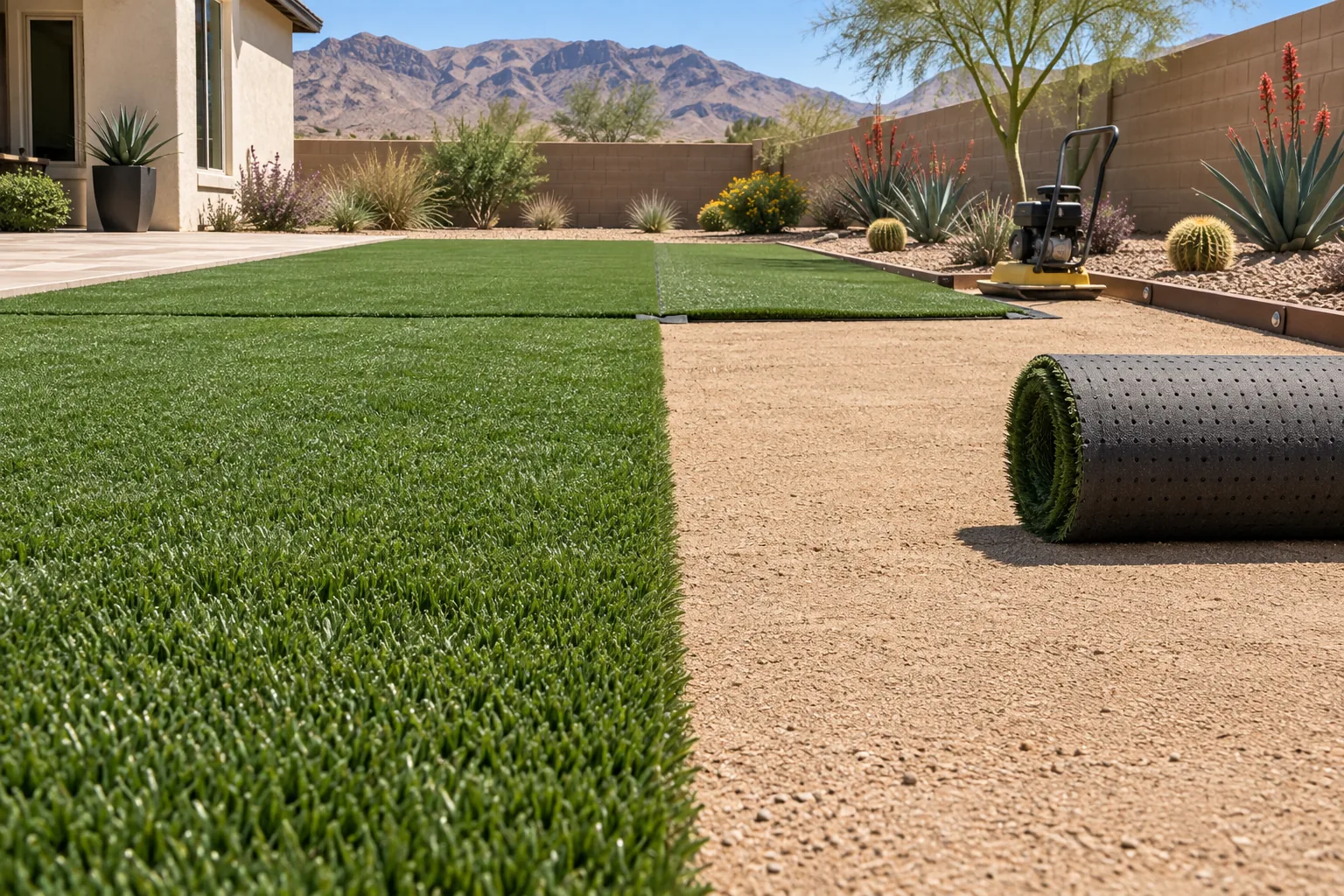 Turf Installation in the Las Vegas valley
Every turf failure we get called to look at is the same failure. Ripples that appear in the second summer. A soft spot that holds water after a monsoon. Seams that lifted. Edges that pulled away from the paver border.
None of that is the product. It is the base. Turf is a surface laid on a structure, and the structure is four to six inches of crushed aggregate, compacted in lifts, graded to drain, with the right fabric and the right edge restraint. Get that wrong and no grade of turf saves you.
Excavate to depth. Lay and compact the aggregate in lifts rather than one dump and a quick pass, because a single thick lift compacts on top and stays loose underneath, which is exactly where the ripple comes from. Grade to fall so water leaves. Set the edge restraint. Then the turf, seamed properly, nailed at the right spacing, infilled at the right rate and brushed up.
Infill is the part people skip to save money. Under-infilled turf lies flat, wears fast and gets hotter, because the infill is what holds the blades upright and what carries heat away from the surface.
Artificial turf in direct Las Vegas sun gets significantly hotter than the air. That is physics, not a product defect, and anyone who tells you otherwise is selling. What changes it is shade, infill choice and where you put it. We will tell you which parts of your yard are a bad idea for turf before you pay for them.
What this covers
The base is the core of a turf installation and the part a homeowner cannot inspect once the turf is down. Excavation depth, removal of organic material, the base material, compaction in lifts and grading to drain all determine how long the lawn lasts.
On caliche, the base has to be chosen with the soil in mind, because water that cannot soak down moves sideways and finds the low spots. A proper base includes a weed barrier and grading that drains the surface into the surrounding grade rather than against the slab.
Seams should fall away from the main sightlines and from where people walk most. Edges need restraint so the turf stays put under foot traffic and in the heat, which makes it move. Anchoring matters where monsoon wind can lift an unsecured edge.
Infill holds the blades upright, affects how the surface feels underfoot, and plays a role in heat and odor. Silica sand, coated sand and antimicrobial options each behave differently, and the right one depends on the use. We recommend the infill for your yard, not the cheapest one.
Turf meets pavers, pool coping and concrete in most yards, and those transitions need the same care as the lawn itself. We plan drainage so water leaves the turf toward the grade rather than pooling at the edge of a slab, and we check what happens to existing irrigation before the turf goes down. Related work: paver patios and pools.
Dig to depth, aggregate laid and compacted in lifts, graded to drain. The part that decides everything.
Fall planned to a real outlet, and perforated drain where the yard has nowhere else to send water.
Seams joined so they disappear and stay down, edges restrained against pavers, walls and granite.
Infill at the correct rate for the pile, brushed in properly, which is what keeps the blades standing and the surface cooler.
Turf is low maintenance, not no maintenance. Cleaning means power brooming the pile back up where traffic has flattened it, topping up infill where it has migrated, rinsing the surface down, and treating pet areas properly rather than hoping the next rain deals with it. Neglected turf does not die, it mats, and matted turf reads as artificial from across the yard in a way that a brushed lawn never does.
Pile height, density and color chosen for the use and the exposure, not from the top of the sample book.
Common questions
How long a turf system lasts depends mostly on the base under it, which is why we talk about the base first.
Yes, in direct sun, noticeably hotter than the air. Shade, infill choice and placement all help. Anyone claiming otherwise has not stood on it in July.
Where we work
We take turf installation work throughout Las Vegas, Henderson, North Las Vegas, Summerlin. Tell us the street and we will tell you honestly whether it is a job we are the right team for.
Start with a conversation