Pump repair and replacement
Seals, bearings, motors and the suction-side problems that caused them.

Pool Service / Pool Repair
Most pool equipment does not fail suddenly. It tells you for weeks first, usually in a sound.
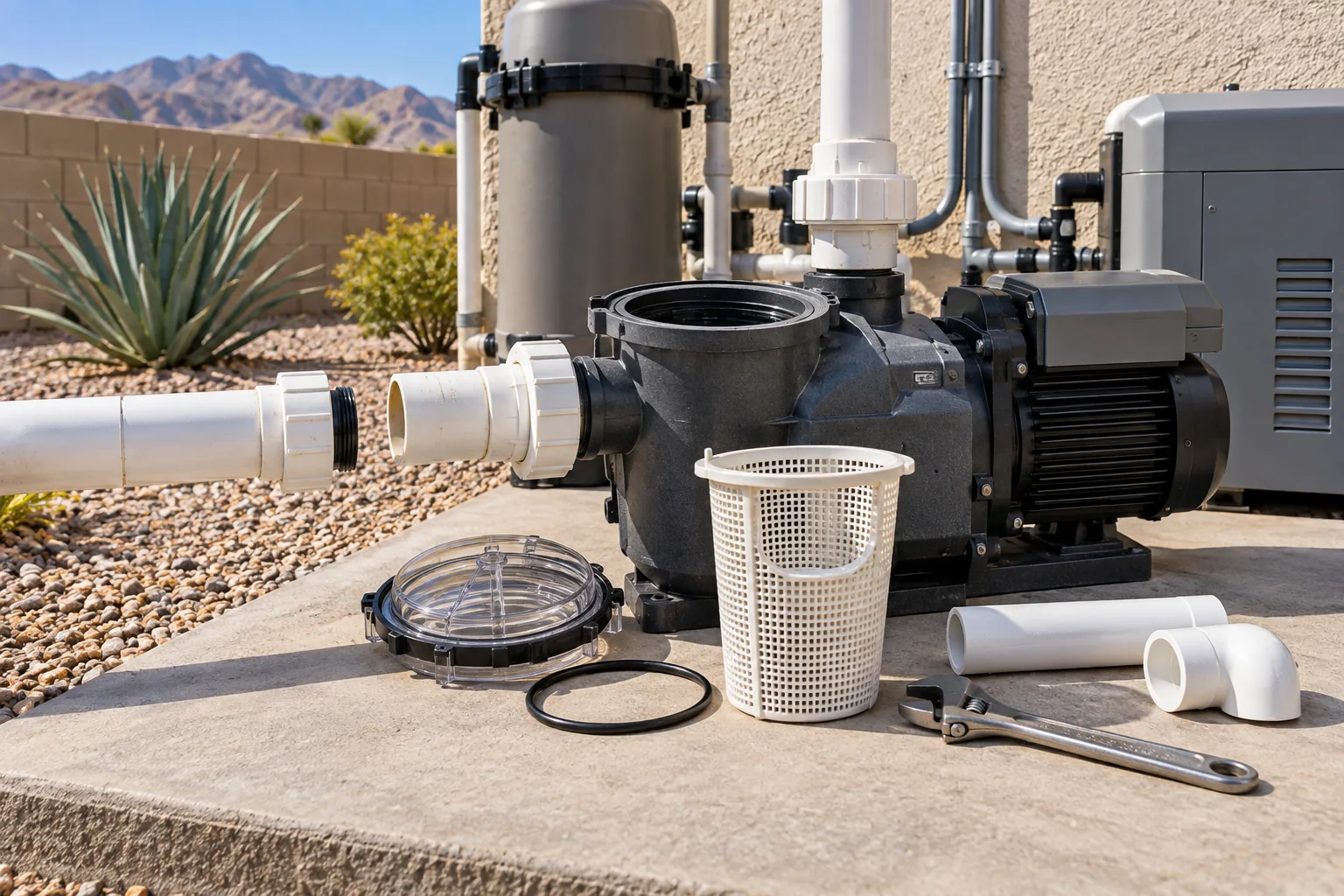 Pool Repair in the Las Vegas valley
The calls split into two groups. Equipment that stopped, which is urgent and usually straightforward. And equipment that is still running while something upstream is wrong, which is where the expensive damage happens.
A pump running dry because of an air leak on the suction side sounds fine for a while and then destroys a seal, then a shaft, then a motor. A heater short-cycling on low flow reports no fault and quietly cooks its heat exchanger. A filter run past its pressure limit pushes debris back into the pool and loads the pump.
Swapping the failed component without finding why it failed gets you the same call in eighteen months. If a pump seal has gone, we want to know whether the plumbing is drawing air. If a heater has failed, we want to know what the flow rate actually is.
That takes an extra half hour and it is the difference between a repair and a subscription.
Urgent: anything electrical, anything leaking into the ground, a pump running dry, and a heater with a fault code it will not clear. Those get worse quickly and cheaply become expensive.
Not urgent: a cosmetic tile chip, a slow weep from a union, a controller that lost its schedule. Real, and worth fixing before it gets worse.
We will tell you which one you have on the phone rather than driving out to tell you in person.
Some equipment brands are well supported here and some are not, and on an out of production unit the availability of one seal can decide repair against replace. We would rather tell you the part is a two week wait from the distributor than fit something approximate and be back.
What this covers
Pumps, motors, filters, heaters, salt cells, automation controllers, lights, plumbing, valves, skimmers and surfaces all fail in predictable ways. A failing pump usually warns first with noise or a drop in flow. A small surface crack left alone becomes a leak, and a weak heater left running can damage the rest of the system.
In summer a Las Vegas pool loses water to evaporation, and homeowners often call it a leak. A simple bucket test tells the two apart: fill a bucket with pool water, mark the water line on the bucket and on the pool, and leave both alone for a day without swimming or running the fill. If the pool drops noticeably more than the bucket, there is likely a leak to track down. If both drop by the same amount, the loss is evaporation.
Once the test points to a leak, a leak detection visit finds where the water is going before anyone breaks concrete. See leak detection.
An uncovered equipment pad in 110-degree ambient heat shortens the life of pumps, heaters and controllers. Shade or a cover reduces the load, and scheduled equipment service catches problems before they stop the pool. See equipment service.
Seals, bearings, motors and the suction-side problems that caused them.
Ignition, flow and heat exchanger faults, with the flow rate checked rather than assumed.
Cracked lines, failed fittings and the joints that open with ground movement.
Multiport valves, cartridges, laterals and the housings that crack under pressure.
Waterline tile, loose coping and the plaster failures that are still small enough to patch.
Common questions
If the unit is out of warranty and the part is more than about half the cost of a new one, replace. We will give you both numbers rather than only the one we would rather do.
We respond within 24 hours of your call during business days.
Where we work
We take pool repair work throughout Las Vegas, Henderson, North Las Vegas, Summerlin. Tell us the street and we will tell you honestly whether it is a job we are the right team for.
Start with a conversation