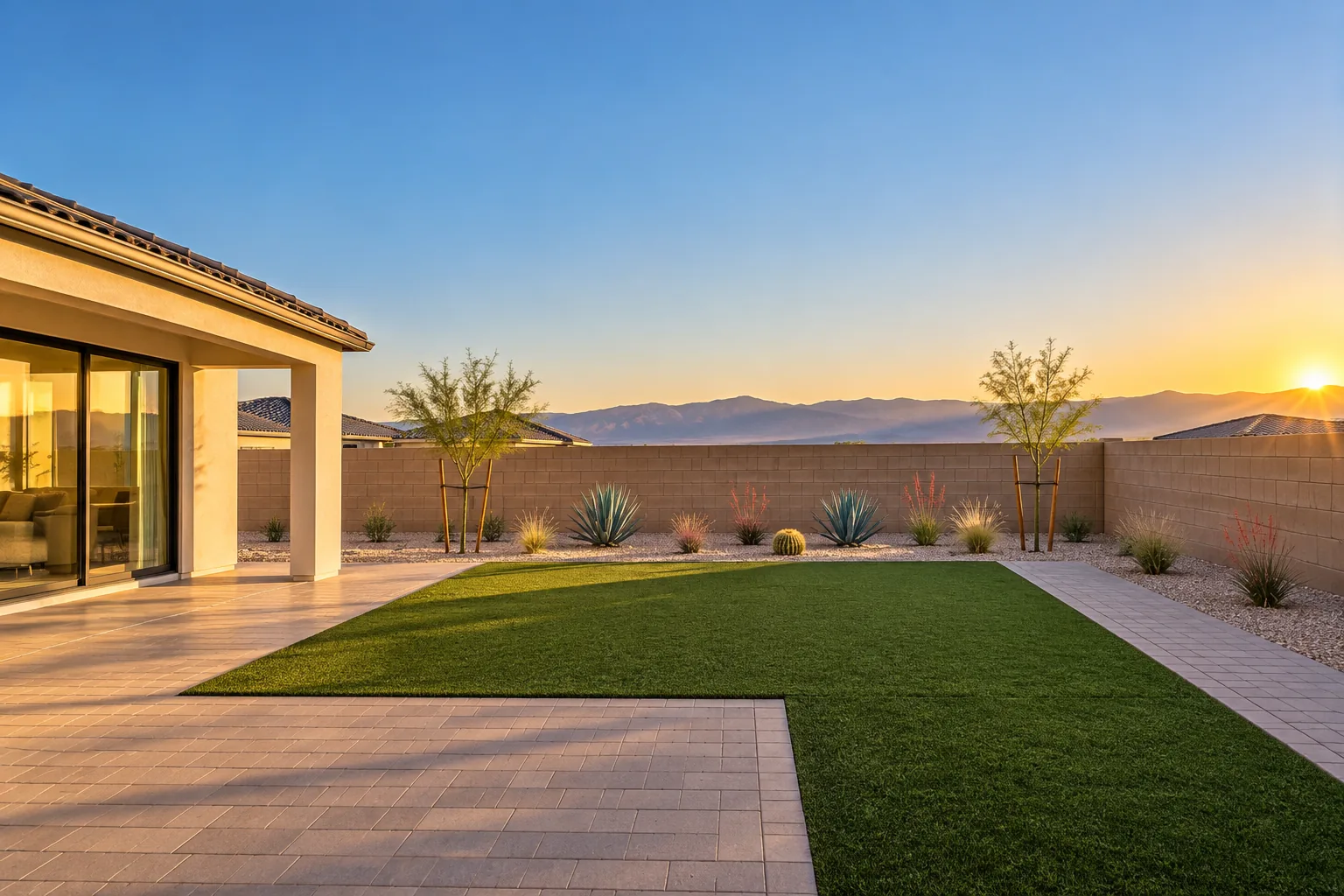
North Las Vegas is the part of the valley where we most often start with nothing. The newer tracts out toward Aliante, Valley Vista and Tule Springs hand over a graded pad, a block wall and a single hose bib, and everything that turns that into a backyard is still in front of you.
That is an advantage, and it is worth using properly. On a bare lot you get to make the buried decisions in the right order for once: irrigation mainline, sleeves under the future deck, conduit for lighting, a gas stub where the kitchen might go and a feed to wherever the pool equipment will live. All of it is cheap while the ground is open. All of it is a saw cut and a patch once the concrete is down. The single most common thing we are asked to repair here is not a broken system, it is a missing one.
The second thing that matters on these lots is elevation. They are close to flat, which people read as easy, and it is the opposite: a flat lot has no natural answer to where water goes once you have added a deck, a raised bed and a lawn. We set the finished heights across the whole yard as one drawing so the first real storm confirms the plan rather than discovering it.
The third is soil. Tract grading leaves the top layers compacted hard, and a planting hole cut to the size of the pot in that material holds water like a bucket and stalls the plant. Beds here get opened up properly. It is the least visible line on the estimate and the one that decides whether the yard looks like it belongs to the house in three years or still looks new.